Skip to content

Every horse is an investment. Know its complete financial story, from conception to sale.

For AQHA breeders running 50–300 head: operations that own their mares, send horses to outside trainers, and need to know where the money actually goes.

30 days free, with full access and sample data to explore. No credit card.

Dashboard with an insight on the largest open position and the expected foalings for December, February and April
The problem

Your books balance. They still can't answer the questions that run a breeding operation.

Accounting knows what the ranch spent. It doesn't know what any one horse cost — the breeding fee sits in one account, six months of feed in another, the trainer's invoices in a third. So the questions that actually move money get answered by feel.

What did this weanling actually cost to raise?
Which mares create wealth, and which quietly eat it?
Which location is draining cash?
Sell now, or keep feeding?
Per-horse financial truth

Every dollar finds its horse

Direct costs post to the horse that incurred them. Shared costs, like the hay fed at a location, insurance or the vet's farm call, are split across the horses that shared them. At foaling, the mare's breeding costs move to the foal. The result is one number per horse: invested cost, current as of today.

  • A complete cost ledger from conception onward
  • Shared costs split across the horses that shared them
  • Breeding costs follow the foal at foaling
Per-horse P&L table listing each horse's basis, direct, shared and breeding costs and total invested
Every horse's invested cost, built from its basis and its direct, shared and breeding costs
Mare productivity

Know which mares earn their keep

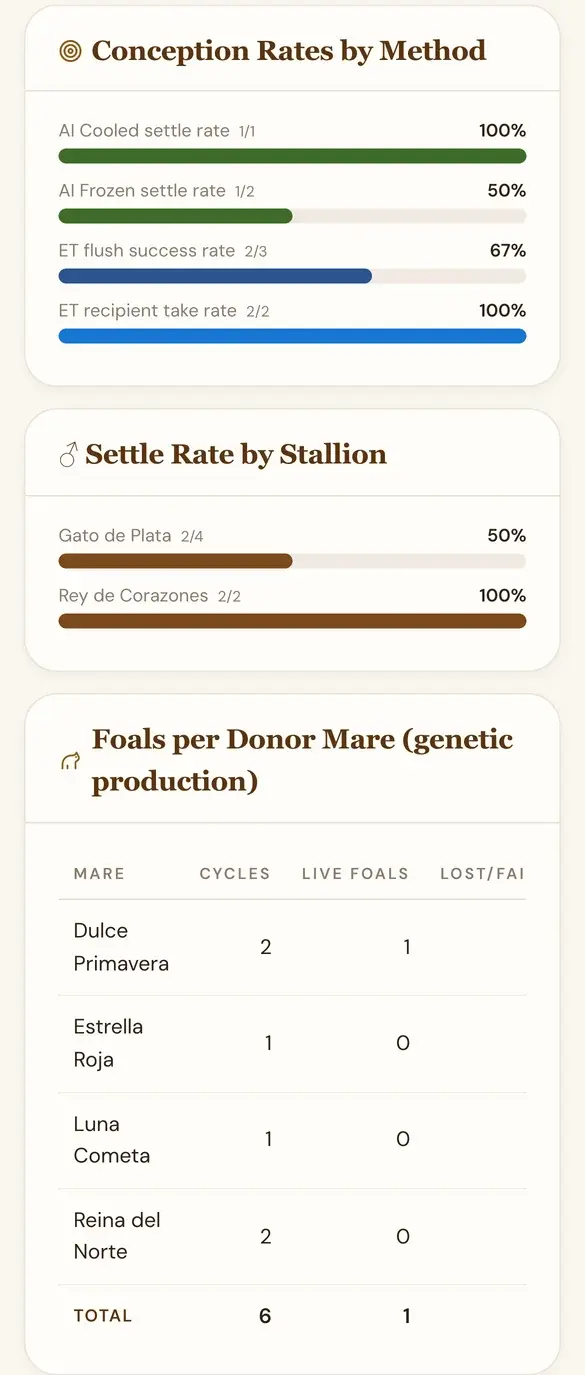
Every breeding cycle is tracked from cover to foaling — including embryo transfers to recipient mares — with its costs attached. Put what a mare's foals cost next to what they returned, and the keep-or-cull decision stops being a gut call.

  • Cycles from cover to foaling, costs attached
  • Cost per live foal, and cost and ROI by mare
  • Expected foalings by month on the dashboard, donors and recipients alike
Breeding report table of four mares with live foals, total cost and cost per foal
Each mare's live foals next to what she has cost
Location & trainer spend

See which location drains cash

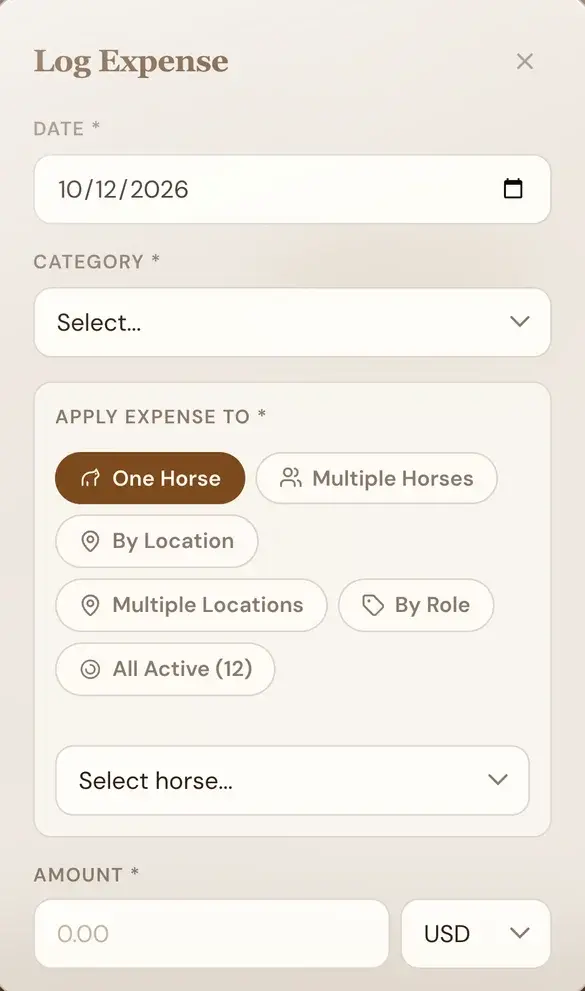
Every expense carries a vendor and the location it applies to. The trainer's barn, the recip pasture, the home ranch: each becomes a cost line you can compare over any period, and forecast before the season starts.

  • Spend by location for any date range, down to the rows behind each total
  • Vendor totals for every trainer and hauler
  • Feed and board forecasts for the months ahead
Location report with the number of purchases and total spend at each location
Spend by location, and every total opens to the rows behind it
The sale decision

Walk into the sale knowing your number

Every horse listed for sale carries its asking price, and the herd P&L puts the projected profit at those prices next to what the herd has cost. Test a sale price against one horse's invested cost before you commit; after the sale, the realized P&L is recorded.

  • Test a sale price against real invested cost
  • Herd-wide consolidated P&L
  • Excel exports and a printable Account Statement for each horse
Herd P&L summary cards: horses included, total invested, total income and projected P/L
Herd P&L: what the whole herd has cost, and the projected profit on the horses listed for sale
The details

Built for the operation you actually run

  • AQHA-first records: certificates, registration numbers, four-generation pedigrees
  • Every screen in English and Spanish, and money in USD or MXN
  • Hay tracked by quality grade, with the oldest cut fed first
  • Roles for the whole crew, every change recorded in Activity, and owner approval before a manager deletes a critical record
  • Vaccination history for every horse, with a printable card
  • Installs on your phone like an app, and exports to Excel for your accountant
Pricing

One founding price, no horse cap

One founding price covers your whole team: owners, managers, vets, any size herd. Pay yearly or monthly, and every account starts with 30 days free.

Founding
$200
per year · USD
or $50 monthly

30-day trial, no card required.

To subscribe, or to ask anything first, write to us.

liberato@aguilabs.com

Your founding price is locked in for as long as your subscription stays active.

Prices in USD. Paying monthly costs more over a year than paying annually.

Questions

Fair questions, straight answers

Is this accounting software?
No — your accountant and your books stay. This is the operational layer accounting can't see: what each horse has cost and what it returned. Export to Excel whenever your accountant wants the detail.
How does the 30-day trial work?
Full access from day one, no credit card. Your ranch starts with sample data so every screen has something in it; clear it in one click from Settings. When the trial ends your records stay readable, nothing is deleted, and changes pause until you subscribe.
Does it work in Spanish and in pesos?
Yes, natively. Every screen is bilingual English/Spanish, and money is tracked in both USD and MXN with exchange rates handled.
Who on my team sees the money?
You decide, with roles. Owners and managers see finances; the vet role works with horses, breeding and health records, not the financial reports. When a manager deletes a critical record, like a horse or an expense, it waits for the owner's approval, and every change is kept in Activity.
How do our existing records get in?
Register your horses with what you have — a basis cost is enough to start — then log costs as they happen. Expenses can be imported from CSV, and the trial is long enough to run a real month alongside your current system.
We're not all AQHA. Is that a problem?
No. The workflow is built around the AQHA registry — certificates, numbers, pedigrees — but grade horses and other registries carry the same complete financial story.

Every horse on your ranch is an investment. Start knowing which ones pay.

Set your operation up in an afternoon. Run it beside your books for 30 days. Keep it if it tells you something you didn't already know.

Start your 30-day trial
Your ranch opens with sample data in it. Clear it in one click when you're ready.